 In September, a representative for the Native American and Indigenous Students Group at NYU, Amanda Foote, reached out to Beyond Buckskin. They wanted to buy the Native Americans Discovered Columbus tee for their Columbus Day events. It was so great to see students initiate positive change, and I was reminded of my days at Dartmouth and the University of Arizona, where I frequently found myself in groups wanting to educate and empower through events. I'm sure you all can relate.
Showing posts with label New York. Show all posts
Showing posts with label New York. Show all posts
October 13, 2015
Indigenous Peoples Day 2015 at NYU
In September, a representative for the Native American and Indigenous Students Group at NYU, Amanda Foote, reached out to Beyond Buckskin. They wanted to buy the Native Americans Discovered Columbus tee for their Columbus Day events. It was so great to see students initiate positive change, and I was reminded of my days at Dartmouth and the University of Arizona, where I frequently found myself in groups wanting to educate and empower through events. I'm sure you all can relate.March 6, 2014
Indigenous New Media and Beyond Buckskin
 New media, technology, the internet: these things have been vital to the expansion of Beyond Buckskin.
This project began in 2005 as a Master's Thesis to investigate the work of Native fashion. It led to my follow-up Doctoral Dissertation on Native American designers of high fashion. Through my research, I interviewed many individuals, and they told me stories, shared their experiences, both positive and negative, about creating clothing and art for the body.
September 7, 2012
Flashback Friday | Is the Fashion Industry Racist?
 The annual Mercedes-Benz Fashion Week officially kicked off yesterday, and I am very excited to see what the designers have in store for us this season.
In addition to checking out the garments, I'm also always very interested to see which designers make the cut, how many of them are minorities, and how many designers select women of color to represent their garments on the runway.
Three years ago, I was new to blogging, but I wrote this quick post, which asked the question, "Is the fashion industry racist?"
February 17, 2012
RED Model Management Seeks Native Models
 Attention Native American and First Nations models, future models, past models, and just, overall, chicks and dudes.
I received an email the other day from a representative at RED Model Management about scouting some Native faces.
October 7, 2011
Diversity on the Catwalk
I love Jezebel.
Mostly because they are not afraid to disclose the ugly side of the fashion industry, and to do it with solid numbers. and graphs.

The Impact Of Diversity On The Catwalk
Every season, New York fashion week comes around, giving us all endless opportunities to gawk at front-row celebrities and trends in the making. And every season, this website tracks the racial diversity — or, more bluntly, the lack thereof — on display among the models who are cast for the top shows. This season's numbers are in, and fashion week was slightly more diverse than usual.
This is good news, obviously — but it's especially good news coming on the heels of last season, which was the whitest in years.
Mostly because they are not afraid to disclose the ugly side of the fashion industry, and to do it with solid numbers. and graphs.

The Impact Of Diversity On The Catwalk
Every season, New York fashion week comes around, giving us all endless opportunities to gawk at front-row celebrities and trends in the making. And every season, this website tracks the racial diversity — or, more bluntly, the lack thereof — on display among the models who are cast for the top shows. This season's numbers are in, and fashion week was slightly more diverse than usual.
This is good news, obviously — but it's especially good news coming on the heels of last season, which was the whitest in years.
April 22, 2011
American Indian Fashion Internships with UNRESERVED Alliance

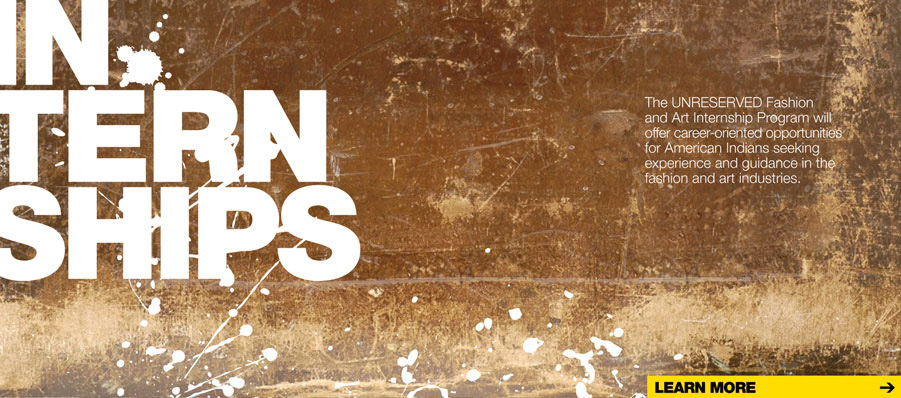
The New York-based non-profit organization UNRESERVED Alliance is currently seeking applicants for its Fashion and Art Internship Program. The first initiative of its kind, this program will offer and develop rare opportunities for American Indians seeking experience and guidance in the fashion and art industries.
UNRESERVED fashion internships will provide entry into the exciting fashion industry by providing invaluable experience with leading designers and firms based on Seventh Avenue and beyond. Prized internships will be available in a range of disciplines including design, fashion buying, merchandising, production and more. To date, industry leaders who have agree to participate include Eileen Fisher, Daryl Kerrigan, Judith Leiber, Pamela Love, Nanette Lepore, Nicole Miller, Urban Zen by Donna Karan and Diane von Furstenberg.
To apply for an American Indian internship program, submit your resume, highlights from your portfolio and a letter explaining your experience and goals. Click here for more information. Applications will be accepted through May 1.
UNRESERVED
Internship Program
55 Bethune Street
13th Floor
New York, NY 10014
212 206-6580
internship@unreservedalliance.org
April 8, 2011
Indianizing The Urban Catwalk

I will be presenting on Native American streetwear at Yale in exactly two weeks! Several Native streetwear artists have offered up their thoughts and insights about this topic and I'm super excited to share it with a broader streetwear audience (aka the folks I'm gonna meet at Yale). In addition, I hope to post snippets about the Native streetwear scene on this blog (you know, as I'm pulling together my Yale presentation), so expect more 'low' fashion posts!

February 21, 2011
Native-Inspired Collections at New York Fashion Week
New York Fashion Week wrapped up this past weekend, and there were several Native-inspired collections presented on the runways. Below is a short list of the collections that demonstrated Native American themes.

ADAM
• This line was inspired by a recent trip to New York’s National Museum of the American Indian. Head designer Adam Lippes said, "I have long felt the American Indian culture to be one of the most beautiful and I walked away from this visit inspired." For more info, click here .
Rag & Bone
• The brand's new collection borrowed from "Eskimos, Inuits, Native Americans and Siberians" — with a few '70s skiers thrown in. For more info, click here.
Cushnie et Ochs
• This collection featured leather, fringe, feathers, and other Native American influences. A road trip from LA to Vegas inspired Carly and Michelle, the designer duo behind Cushnie et Ochs, to bring some fringe and feathers to their Fall collection. Metro.us asked the designers at Cushnie et Ochs, "What was your inspiration for fall?" and they responded: "The collection became about Western travel — like a sultry, sexy vagabond traveling around. We looked at Native American silhouettes also, so it was kinda that mixed together. It was taking some of the Native American references, like the elastic boning and the fringes, and cleaning them up." For more info, click here or here or here or here.


Diane von Furstenberg
• Three icons of old-school style and allure were muse choices for Diane von Furstenberg's 'American Legend'-themed show for Fall 2011, and one of them included Millicent Rogers - a grand Standard Oil dame who had a thing for Native American and Rodeo wear. For more info, click here.
Rodarte
• Nicholas Kirkwood for Rodarte booties drew on a Native theme, with beaded crystal patterns clearly inspired by Native American designs. For more info, click here.
Band of Outsiders
• The Band of Outsiders show evoked university graduates in college scarves, Native American-inspired graphic cardigans and wool blanket coats. For more info, click here or here.
Proenza Schouler
• Proenza Schouler goes into the West. Head designers Lazaro Hernandez and Jack McCollough were inspired by a road trip across the “Wild West,” from Santa Fe to Wyoming, where they collected Native American blankets and textiles. The geometric patterns and other objects were scanned, then manipulated on a computer and turned into wool jacquards. For more info, click here or here or here.


Sophie Theallet
• Sophie Theallet said that the grace and strength that is apparent in the lifestyle of Native Americans inspired this latest collection. In the developing stages of this collection, she said she spent considerable time at a Canadian reserve (though she doesn't say which one) to inspect the elements of Native clothes from close quarters. She said that the beauty and grace apparent in the clothes of these people deeply touched her heart. For more info, click here.


ADAM
• This line was inspired by a recent trip to New York’s National Museum of the American Indian. Head designer Adam Lippes said, "I have long felt the American Indian culture to be one of the most beautiful and I walked away from this visit inspired." For more info, click here .
Rag & Bone
• The brand's new collection borrowed from "Eskimos, Inuits, Native Americans and Siberians" — with a few '70s skiers thrown in. For more info, click here.
Cushnie et Ochs
• This collection featured leather, fringe, feathers, and other Native American influences. A road trip from LA to Vegas inspired Carly and Michelle, the designer duo behind Cushnie et Ochs, to bring some fringe and feathers to their Fall collection. Metro.us asked the designers at Cushnie et Ochs, "What was your inspiration for fall?" and they responded: "The collection became about Western travel — like a sultry, sexy vagabond traveling around. We looked at Native American silhouettes also, so it was kinda that mixed together. It was taking some of the Native American references, like the elastic boning and the fringes, and cleaning them up." For more info, click here or here or here or here.

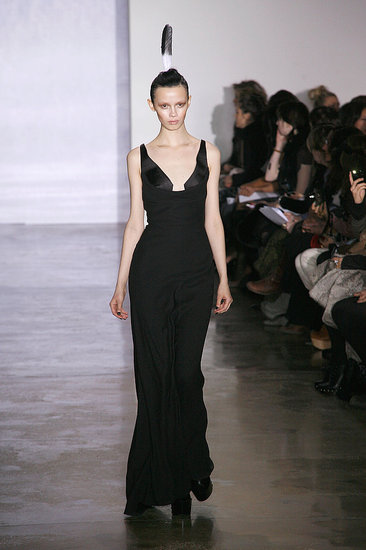
Diane von Furstenberg
• Three icons of old-school style and allure were muse choices for Diane von Furstenberg's 'American Legend'-themed show for Fall 2011, and one of them included Millicent Rogers - a grand Standard Oil dame who had a thing for Native American and Rodeo wear. For more info, click here.
Rodarte
• Nicholas Kirkwood for Rodarte booties drew on a Native theme, with beaded crystal patterns clearly inspired by Native American designs. For more info, click here.
Band of Outsiders
• The Band of Outsiders show evoked university graduates in college scarves, Native American-inspired graphic cardigans and wool blanket coats. For more info, click here or here.
Proenza Schouler
• Proenza Schouler goes into the West. Head designers Lazaro Hernandez and Jack McCollough were inspired by a road trip across the “Wild West,” from Santa Fe to Wyoming, where they collected Native American blankets and textiles. The geometric patterns and other objects were scanned, then manipulated on a computer and turned into wool jacquards. For more info, click here or here or here.


Sophie Theallet
• Sophie Theallet said that the grace and strength that is apparent in the lifestyle of Native Americans inspired this latest collection. In the developing stages of this collection, she said she spent considerable time at a Canadian reserve (though she doesn't say which one) to inspect the elements of Native clothes from close quarters. She said that the beauty and grace apparent in the clothes of these people deeply touched her heart. For more info, click here.

September 27, 2010
Jezebel Reports: Fashion Week Diversity By The Numbers
Jezebel Reports:
Fashion Week Diversity By The Numbers
By Jenna Sauers
In September of 2007, it was reported that of all the 101 shows that took place during New York fashion week, one third employed zero models of color. Since then, we've tried to track diversity on the runway every season.
We do this here at Jezebel because what we see on the runway — and who wears it — influences the faces we will go on to see in magazine editorials, advertising campaigns, and all the other images the fashion industry will create over the coming season. The models who walk in the shows are working with the stylists who matter, and being seen by the top editors. Those stylists are thinking of the campaigns, editorials, and other jobs they'll be consulting on over the coming months; the editors are thinking of their feature wells and the garments and stories and faces that might fill them. The industry at large is watching these shows and thinking: Who has buzz? Who's that new face? Who do we have to have? The runway is like a hopper that feeds the fashion industry's image-making machine. And the fact is that those images overwhelmingly feature white faces; this, we believe, perpetuates the cycle of marginalization and racism experienced by people of color.
Even if, come spring, you don't buy any of the overpriced designer clothes fashion week notionally exists to unveil, and even if you are not a habitual reader of the hard-core fashion magazines, chances are you'll still be bombarded with the perfume ads, the Gap campaigns, and the Maybelline billboards — not to mention the garden variety ladymag editorials — that will stem from this season and its casting.
This fashion week, there were 128 New York shows and presentations that were covered by Style.com. (We've always used Style.com as the basis for our data because it publishes look-by-look slideshows, often with models' names included, for a comprehensive swath of New York's shows.) Those 128 shows together presented 4,170 runway looks. That means 4,170 opportunities to choose a woman or girl to model that outfit.

3,410 of those opportunities, or 81.8%, went to white models. That means of course that 760, or 18.2%, went to models who were non-white. Non-white Latina models were used 95 times in all of fashion week, or around 2.3% of the time, and Asian models were used 296 times, or 7.1% of the time. Black models were used 353 times, or 8.4% of the time. Models of other races, like the Moroccan Hind Sahli and the Canadian model Tara Gill, who has Native American heritage, were used 16 times, or 0.4% of the time.
Since Jezebel has been been tracking the relative diversity of New York fashion week for so many seasons, I thought I'd try and chart the last few seasons and their numbers. (We did not generate data for Spring/Summer 2009, or Spring/Summer 2010.) You will notice that this season presents a small improvement on six months ago, in terms of its diversity, but that essentially New York fashion week is right back where it was 18 months ago.

Lots of people within fashion will tell you that casting models is an extraordinarily complex, creative pursuit, one that requires balancing multiple subjective qualities (does this model give me the right feeling?) with more objective ones (does this model fit the clothes, and can she walk?). Some people always say that choosing a cast that suits a designer's creative vision is more important than taking even the most basic steps to insure that cast isn't all-white. (At least, the apologists for the status quo prefer to talk about designers and "creative visions" rather than about casting notices that say "No Ethnic Girls" and black models who say they work less than their white friends.) But why is it considered acceptable for a designer's creative vision to not include people of color? Do those designers not want any black or Latino customers either?
This season, there were six shows and presentations that included no models of color at all. These included Philosophy di Alberta Ferretti — which is cast by the highly influential casting director Russell Marsh, who also casts for Prada and Miu Miu — as well as Mulberry, Reem Acra, and Doo.Ri. Prada, you will recall, is the Italian global luxury brand that went more than a decade without casting even a single black model in any of its shows. (This season, Prada had two black models — Jourdan Dunn and Melodie Monrose — present one look apiece in its 41-look collection.)
There were also plenty of shows that had all-white casts but for one or two models. Anna Sui, Calvin Klein, Donna Karan, Jeremy Scott, Jill Stuart, Narciso Rodriguez, Rodarte, Diesel Black Gold, and Thakoon are among them. What's worrisome is that that list is thick with some of the most influential and prestigious labels in all of fashion. And they don't seem to see any use for more than a couple token models of color. Mass-market powerhouse Max Azria, via his brands Hervé Leger by Max Azria, Max Azria, and BCBG Max Azria, booked his customary nearly all-white casts, all while telling us he was the "king of diversity in fashion."
Who were the designers who did things better? 3.1 Phillip Lim, who hired nine models of color, and Sophie Théallet, who showed 13 of her 32 looks on models of color, were among the buzzed-about younger designers had very diverse casts. Among the old guard, Carolina Herrera (11/52), Oscar de la Renta (13/60), and Diane von Furstenberg (17/50), had the most diverse casts. Rachel Comey, Betsey Johnson, Costello Tagliapietra, Tara Subkoff's relaunched Imitation line, Jason Wu, Christian Siriano, Gwen Stefani's L.A.M.B. line, both Marc Jacobs and Marc by Marc Jacobs, and Richard Chai were also among those labels that valued diversity in their casting.
Melodie Monrose, with 19 shows including Tory Burch and Rag & Bone, was fashion week's top black model. Shena Moulton and Joan Smalls, who booked 13 apiece, were second. Moulton was the only black model at Calvin Klein, and Smalls walked for Alexander Wang, Derek Lam, and Michael Kors, among others. The top Asian model at New York fashion week was again Liu Wen, who walked in 18 shows. Fei Fei Sun and Shu Pei Qin had 16 each. Among non-white Latina models, Simone Carvalho booked nine shows, while Juana Burga had a respectable eight. The only models of other ethnic backgrounds to speak of were Hind Sahli, who worked six shows, and Tara Gill, who booked three.
Why doesn't fashion — especially multi-national brands whose profitability rests on convincing the largest number of consumers possible to purchase their perfumes, underwear, and diffusion lines, like Calvin Klein — have more consideration for the beauty and worth of people who aren't white? Is New York fashion week plateauing at around 82% white, no matter how much advocacy or consciousness-raising gets done, or how many trend pieces get written about this issue? Will it ever become unacceptable to put on a fashion show in a thoroughly multi-racial city like New York and not hire a single model of color? Will it ever become unacceptable to blame that choice on an alleged "creative vision"? As long as these questions remain, we'll continue to ask them, time and time again, and look for answers in seasons to come.
Fashion Week Diversity By The Numbers
By Jenna Sauers
In September of 2007, it was reported that of all the 101 shows that took place during New York fashion week, one third employed zero models of color. Since then, we've tried to track diversity on the runway every season.
We do this here at Jezebel because what we see on the runway — and who wears it — influences the faces we will go on to see in magazine editorials, advertising campaigns, and all the other images the fashion industry will create over the coming season. The models who walk in the shows are working with the stylists who matter, and being seen by the top editors. Those stylists are thinking of the campaigns, editorials, and other jobs they'll be consulting on over the coming months; the editors are thinking of their feature wells and the garments and stories and faces that might fill them. The industry at large is watching these shows and thinking: Who has buzz? Who's that new face? Who do we have to have? The runway is like a hopper that feeds the fashion industry's image-making machine. And the fact is that those images overwhelmingly feature white faces; this, we believe, perpetuates the cycle of marginalization and racism experienced by people of color.
Even if, come spring, you don't buy any of the overpriced designer clothes fashion week notionally exists to unveil, and even if you are not a habitual reader of the hard-core fashion magazines, chances are you'll still be bombarded with the perfume ads, the Gap campaigns, and the Maybelline billboards — not to mention the garden variety ladymag editorials — that will stem from this season and its casting.
This fashion week, there were 128 New York shows and presentations that were covered by Style.com. (We've always used Style.com as the basis for our data because it publishes look-by-look slideshows, often with models' names included, for a comprehensive swath of New York's shows.) Those 128 shows together presented 4,170 runway looks. That means 4,170 opportunities to choose a woman or girl to model that outfit.

3,410 of those opportunities, or 81.8%, went to white models. That means of course that 760, or 18.2%, went to models who were non-white. Non-white Latina models were used 95 times in all of fashion week, or around 2.3% of the time, and Asian models were used 296 times, or 7.1% of the time. Black models were used 353 times, or 8.4% of the time. Models of other races, like the Moroccan Hind Sahli and the Canadian model Tara Gill, who has Native American heritage, were used 16 times, or 0.4% of the time.
Since Jezebel has been been tracking the relative diversity of New York fashion week for so many seasons, I thought I'd try and chart the last few seasons and their numbers. (We did not generate data for Spring/Summer 2009, or Spring/Summer 2010.) You will notice that this season presents a small improvement on six months ago, in terms of its diversity, but that essentially New York fashion week is right back where it was 18 months ago.

Lots of people within fashion will tell you that casting models is an extraordinarily complex, creative pursuit, one that requires balancing multiple subjective qualities (does this model give me the right feeling?) with more objective ones (does this model fit the clothes, and can she walk?). Some people always say that choosing a cast that suits a designer's creative vision is more important than taking even the most basic steps to insure that cast isn't all-white. (At least, the apologists for the status quo prefer to talk about designers and "creative visions" rather than about casting notices that say "No Ethnic Girls" and black models who say they work less than their white friends.) But why is it considered acceptable for a designer's creative vision to not include people of color? Do those designers not want any black or Latino customers either?
This season, there were six shows and presentations that included no models of color at all. These included Philosophy di Alberta Ferretti — which is cast by the highly influential casting director Russell Marsh, who also casts for Prada and Miu Miu — as well as Mulberry, Reem Acra, and Doo.Ri. Prada, you will recall, is the Italian global luxury brand that went more than a decade without casting even a single black model in any of its shows. (This season, Prada had two black models — Jourdan Dunn and Melodie Monrose — present one look apiece in its 41-look collection.)
There were also plenty of shows that had all-white casts but for one or two models. Anna Sui, Calvin Klein, Donna Karan, Jeremy Scott, Jill Stuart, Narciso Rodriguez, Rodarte, Diesel Black Gold, and Thakoon are among them. What's worrisome is that that list is thick with some of the most influential and prestigious labels in all of fashion. And they don't seem to see any use for more than a couple token models of color. Mass-market powerhouse Max Azria, via his brands Hervé Leger by Max Azria, Max Azria, and BCBG Max Azria, booked his customary nearly all-white casts, all while telling us he was the "king of diversity in fashion."
Who were the designers who did things better? 3.1 Phillip Lim, who hired nine models of color, and Sophie Théallet, who showed 13 of her 32 looks on models of color, were among the buzzed-about younger designers had very diverse casts. Among the old guard, Carolina Herrera (11/52), Oscar de la Renta (13/60), and Diane von Furstenberg (17/50), had the most diverse casts. Rachel Comey, Betsey Johnson, Costello Tagliapietra, Tara Subkoff's relaunched Imitation line, Jason Wu, Christian Siriano, Gwen Stefani's L.A.M.B. line, both Marc Jacobs and Marc by Marc Jacobs, and Richard Chai were also among those labels that valued diversity in their casting.
Melodie Monrose, with 19 shows including Tory Burch and Rag & Bone, was fashion week's top black model. Shena Moulton and Joan Smalls, who booked 13 apiece, were second. Moulton was the only black model at Calvin Klein, and Smalls walked for Alexander Wang, Derek Lam, and Michael Kors, among others. The top Asian model at New York fashion week was again Liu Wen, who walked in 18 shows. Fei Fei Sun and Shu Pei Qin had 16 each. Among non-white Latina models, Simone Carvalho booked nine shows, while Juana Burga had a respectable eight. The only models of other ethnic backgrounds to speak of were Hind Sahli, who worked six shows, and Tara Gill, who booked three.
Why doesn't fashion — especially multi-national brands whose profitability rests on convincing the largest number of consumers possible to purchase their perfumes, underwear, and diffusion lines, like Calvin Klein — have more consideration for the beauty and worth of people who aren't white? Is New York fashion week plateauing at around 82% white, no matter how much advocacy or consciousness-raising gets done, or how many trend pieces get written about this issue? Will it ever become unacceptable to put on a fashion show in a thoroughly multi-racial city like New York and not hire a single model of color? Will it ever become unacceptable to blame that choice on an alleged "creative vision"? As long as these questions remain, we'll continue to ask them, time and time again, and look for answers in seasons to come.
June 11, 2010
Africa Fashion Week

So, I'm a lil behind the times, but I just came across this official announcement (released in February) that New York City's Mayor Bloomberg proclaimed July 12th-17th to be Africa Fashion Week in NYC. [see below]
Their vision and mission are pretty straightforward, but much-needed: The vision of this program is to 'Break through the New York fashion noise and allow diverse and upcoming designers to voice themselves through creative forums.' And the mission is to 'Raise awareness and market diverse fashion professional’s talents and skills.'
The New York Africa Fashion Week has also been globally recognized, and was added to the the International Fashion Week Calendar. Africa’s growing impact in fashion cannot be disputed. Its influence can be seen on runways and in stores all over the world.
Geared towards Africa and its influences in fashion and entertainment, the AFW will be a place for fashion professionals, entertainers, and writers of African descent to come together and showcase their creativity.
Official Announcement:
It's Official! New York City's Mayor Bloomberg Will Proclaim July 12th - July 17th Africa Fashion Week.
Friday, February 26, 2010 at 9:27am
The office of New York City's Mayor Michael Bloomberg will officially proclaim the week of July 12th thru July 17th Africa Fashion Week in New York City, a historical endorsement for Africans and African-Americans in the fashion and entertainment industry.
Africa Fashion Week NY is a luxurious, multi-day event which includes runway shows, exhibitions, and industry networking events - all with the purpose of raising awareness of the African / African-American fashion & entertainment professionals in the New York and Tri-State area.
Accordingly, this nationally formed week of diversity centric fashion events will henceforth be celebrated annually from July 12th thru July 17th.
Visit http://africafashionweekny.com/ to learn more about Africa Fashion Week NY.
[images below are from the Arise African Collective fashion show during Mercedes-Benz Fashion Week 2010]


March 4, 2010
Exhibit | HIDE: Skin as Material and Metaphor

 (KC Adams - Cyborg Hybrid Donna, 2009)
HIDE: Skin as Material and Metaphor is a two-part exhibition at The National Museum of the American Indian, George Gustav Heye Center in New York, NY. Part I will be open to the public March 6, 2010 until August 1, 2010. Part II will be open to the public September 4, 2010 until January 16, 2011.
• SONYA KELLIHER-COMBS: MARCH 6–AUGUST 1, 2010
• NADIA MYRE: MARCH 6–AUGUST 1, 2010
• MICHAEL BELMORE: SEPTEMBER 4, 2010–JANUARY 16, 2011
• PHOTOGRAPHY/SHOWING SKIN: SEPTEMBER 4, 2010–JANUARY 16, 2011
For Native people, skin encompasses an entire universe of meaning. Our own skin functions as a canvas that we can inscribe with messages about our identity or use as a shield to protect and hide our secrets. As a material, animal skin or hide has had a long history within Native culture. It is a symbolic reminder of historical misrepresentation, exploitation, and racial politics. The artists selected for HIDE draw upon this subject in multi-faceted ways, using both the material and concept of skin as a metaphor for widespread issues surrounding identity and personal, historical, and environmental trauma and perseverance. In their work, they interrupt our understanding of race, distort our perception of “skin,” and breach the artificial boundaries created by this potent subject matter. Rather than hiding difficult issues, they expose what is beneath the surface.
Sonya Kelliher-Combs, Nadia Myre, and Michael Belmore each present bodies of sculptural and mixed-media work that explore skin as a surface—revealing, concealing, and defining. The work of these artists awakens the senses, drawing the audience into a tactile experience of the materiality of their work as well as making them think about the complex ideas that emerge from this compelling art. The photographers invited to participate in the exhibition—Arthur Renwick, KC Adams, Terrance Houle, Rosalie Favell, and Sarah Sense—have created a diverse collection of portraits that play with and challenge our notions about the representation of Native people.
Kathleen Ash-Milby, Curator
For more information go to: http://www.nmai.si.edu/exhibitions/hide/
February 22, 2010
Video | UNRESERVED Native New York Fashion Week
Check out this video, by wwd.com, featuring the designers of the UNRESERVED Alliance Designer Collective event, held in New York during Fashion Week. This video covers three segments: Vena Cava, UNRESERVED, and L.A.M.B.
The Native shpeel starts at the 1 minute mark. This type of coverage for a Native fashion event is great (WWD!) - but they could have been a wee bit more creative when selecting the background music... but that's just my opinion!
February 21, 2010
Maya Stewart Featured in Tulsa World Newspaper


 By STACY PRATT
World Correspondent
Published: 2/21/2010 2:27 AM
Editor's Note: Stacy Pratt is an Oklahoma native now living in New York with her husband, a U.S. Army staff sergeant and Oklahoma native stationed at Fort Drum. Pratt's cousin is Maya Stewart, a Washington, Okla., native who started a line of handbags featured in this year's New York Fashion Week, held last week.
NEW YORK — Bryant Park is covered with the remains of yesterday's big snow, but a bright sun shines on the famous white tents that have taken over this peaceful oasis in the middle of Manhattan.
Muffled music from the runway shows inside them serves as a soundtrack to the action outside: Security guards check invitations and press passes of expensively dressed socialites and journalists in comfortable shoes. Television crews shoot teasers for interviews with models and designers whose names and faces make regular appearances in the biggest fashion magazines.
At the park's round green tables, men play cards as they probably do every day, seemingly oblivious to the fact that this is Mercedes-Benz New York Fashion Week — the week when designers unveil their spring collections for the press, department store buyers and anyone else lucky enough to score a coveted invitation to the event's last year at this landmark location.
While the white tents have been a symbol of New York Fashion Week since its inception in 1943, shows are held all over Manhattan, including right across the street from the tents in historic Bryant Park Hotel. That's where I caught up with native Oklahoman accessories designer Maya Stewart, creator of the Crazy Snake Rebellion luxury handbag line, on Thursday, day two of the prestigious event.
In the swank red-leather lobby, she was waiting for news about a box of purses that was supposed to have arrived in New York the day before. It was sent several days ahead of time by overnight mail, but the mid-Atlantic blizzard delayed it. Now, two hours before she is due to make her Fashion Week debut as part of the UNRESERVED Designer Collective installation show in Bryant Park Hotel Loft, the purses are still en route from Oklahoma.
Most people would panic in this situation, but Stewart — who originally hails from the small town of Washington in central Oklahoma — appears completely unruffled. In an outfit of tall boots, black leggings, and a diaphanous white blouse topped by a sleek black blazer, she fits right in with the rest of the fashionably attired people in the lobby, most of whom are watching a television crew film a piece about Canadian supermodel Coco Rocha. After placing courteous, calm calls to the appropriate authorities, she grabs her things and heads toward the Loft.
"Most of the bags did make it here," Stewart says. "I really wish I had all of them, but at least I have enough to represent the collection, and the rest should arrive in time for the trunk show tomorrow."
N.M. to N.Y.
Michael Chapman and Gail Bruce, co-founders of UNRESERVED, said this kind of professional confidence, along with Stewart's innovative, high-quality work, is what convinced them to make her part of the collective's inaugural Fashion Week show.
"We met Maya at the Santa Fe Indian Market, and our PR company was blown away by her talent. We thought she'd be a great person to bring in for our first show," said Chapman. "Her enthusiasm and her talent stood out to us right away."
The Designer Collective is part of the UNRESERVED American Indian Fashion and Art Alliance, an organization formed to provide internships and other professional opportunities for American Indian designers from all tribes. Eileen Fisher, Daryl Kerrigan, Nanette Lepore, Pamela Love, Nicole Miller, Urban Zen by Donna Karan and Diane von Furstenberg are among those who have agreed to sponsor UNRESERVED interns in the coming year.
Before her involvement with UNRESERVED, Stewart, who lived in Los Angeles for several years before to moving to London for college, did internships with British designer Matthew Williamson and Los Angeles designer C.C. Skye. Bruce calls her a "shining example of what internships can do."
Chapman agrees, and says that UNRESERVED hopes to help Stewart, and the other three American Indian designers in the show, reach the next level in their careers.
"We are committed to opening up a new frontier, a new realm, for native designers through entry-level internships and other opportunities," he said. "With Maya, we want to introduce her to the press, potential backers and buyers for department stores so people can appreciate and celebrate her talent."
Bruce said Stewart's work also supports the creative goals of UNRESERVED.
"One of our goals is to bring native cultures from the past into the present with an eye to the future," she said.
Stewart, who is finishing a bachelor's degree with honors in accessories design at the London College of Fashion, does that, creating purses and bags that incorporate designs from her Chickasaw/Creek heritage into contemporary forms, using modern luxury materials and traditional techniques.
She is part of the Fife family of designers whose artwork and fashion designs were recently featuredin a retrospective at the Broken Arrow Historical Society Museum.
"The goal of my collection is to showcase the beauty of American Indian designs using modern materials," Stewart said. "Nothing else is like it, and there are so many designs and techniques that are slowly being lost. I want to help keep them in our native communities and also share them with the wider global community."
All of the bags are varying textures and shades of black, created from fine lambskin. All of them are exquisitely constructed using techniques and designs ranging from Seminole patchwork to a raised image of a Pomo basket pattern. But it was the brilliant cerulean blue that lines the inside of many of the bags that began her inspiration.
"The theme of this collection is 'astronomy,' and the idea behind it actually began with this amazing blue," she said. "At that time, I was talking a lot to my aunt, Phyllis Fife, who directs the NSU Symposium on the American Indian in Tahlequah, and the theme that year was 'Sun, Moon, Stars,' so the importance of the sky to our native cultures was on my mind. When I saw this color, I knew I wanted to create a collection that would reflect that reverence in a subtle but powerful way."
Great opportunity
For the Loft show, Stewart's purses and a hand-woven sash made of thin nylon cords created by her aunt, artist Sandy Wilson of Morris, are displayed on two large wooden discs. The natural textures both contrast with and complement the modern lines and ancient patterns of the purses.
For almost five hours, Stewart stands next to her collection answering questions from members of the fashion media, including several respected industry publications, as well as buyers from major department stores and private collectors.
The next afternoon, Stewart once again arranges her collection — this time with the formerly missing bags included — and prepares for the trunk show and cocktail party that follows. This event is held in the elegant Ramscale Studios Penthouse on the banks of the Hudson River. Featured in several television shows and movies, the 13th-floor penthouse has high ceilings and huge windows that face the Empire State Building on one side and the Statue of Liberty on another.
"I'm so glad to have all the bags here," she says. "I put so much into this collection, and it's gratifying to have so many people come by to see it."
About the event
These days, around 40 fashion weeks are held across the world, from Los Angeles to Johannesburg, but New York Fashion Week is the oldest of the lot. Begun in 1943 by fashion editor Eleanor Lambert, the event was originally called Press Week. Lambert organized it because Francewas then occupied by Germany, cutting the American fashion press off from its usual source of news.
This first event also heralded a new attention to American designers, who until then were all but ignored in favor of the French. Today, New York Fashion Week is one of the four largest and most important fashion weeks, along with Milan, Paris and London.
This year marks the UNRESERVED Alliance’s first show at New York Fashion Week. In addition to showcasingup-and-coming Native American designers Maya Stewart, Victoria and Dylan Poblano, Maria Samora and Patricia Michaels, this year’s show marks the beginning of the organization’s fashion internship program.
For more information on the UNRESERVED Alliance internship program, visit unreservedalliance.org.
Read more from this Tulsa World article at http://www.tulsaworld.com/scene/article.aspx?subjectid=43&articleid=20100221_43_D4_MayaSt662241&rss_lnk=4
Breaking into the New York Fashion Scene


Here’s another post about the UNRESERVED Alliance event in New York during Fashion Week (Written by WGSN Americas blog). It is great to see so many (albeit brief) responses to the UNRESERVED Alliance Native fashion events (which were two trunk shows: one on Thursday and one on Friday).
I attended the UNRESERVED trunk show on Friday at Ramscale Penthouse Studios, and was curious if the Native fashion events were ‘a success.’ UNRESERVED co-founder Gail Bruce told me that the Thursday event went well – it was a trunk show at the Bryant Park Hotel Loft. Instead of doing a full fashion show, they wanted to create a more intimate environment where members of the press could attend and interact with the designers. One of the most important aspects of Fashion Week is getting press coverage – this is the reason why the New York Fashion Week launched in the first place during the post-war era: if you create one event where the best of America’s designers will share their work, the press will attend and review, discuss, and promote the fashion designs in various publications (the top being magazines like Vogue or Harpers Bazaar). So, 'success' is gauged by press coverage.
One of the goals of the UNRESERVED Alliance is to get Native American designers and artists into the New York scene since it is our country’s fashion and art mecca (some of my New York friends disagree – citing the recent emergence of new art centers and the decentralizing of the art world due to increased mobilization – but that’s a different story!). On a basic level, UNRESERVED most definitely accomplishes this goal – they were able to get designers into New York. However, it is my opinion that the events were small. New York is big, there are many events going on, and members of the press expect fantastic shows to report on. Basically, Native artists and designers (and their show coordinators) need to bring their A game. We're competing with 'the best of the best' for press attention. The post by WGSN (below) states that there were several culture-specific events at Fashion Week – but we need to be more than just a cultural event, we need to be a top-notch fashion event. Depending on promotion as a cultural-event runs the risk of ‘ghettoizing’ Native fashion designers.
It is my hope that UNRESERVED will continue their effort in the years to come, and will host an actual ‘fashion show’ during NY Fashion Week. I also hope they will recognized the necessity to support the designers in building the infrastructural business side of their labels, so that when they do show at Bryant Park, the designers will be able to follow through with the responses (to fulfill orders) that will undoubtedly occur with a showing of Native fashion.
WSGN wrote:
This season we are seeing an increased number of country or culture-specific events. In this case, the American Indian alliance offered a look into the collections of a few very talented Native American designers.
Veronica and Dylan Poblano previewed a hand-created jewelry line in bright colors and traditional stone finishes and patterns.
Maya Stweart's bags combine modern aesthetics with traditional, Native American patterns and shapes.
Patricia Michaels offered a look into her line of women's clothing. Leather, silk and wool are used in unique ways to create contemporary-looking silhouettes with deep connection to Indian heritage.
WGSN focuses on the trends that the US, Central and South American teams are tracking now. WGSN publishes thousands of news and business stories each year, reacting to the events and issues in the fashion and style industries worldwide, predicting what will matter to industry professionals now and in the future.
February 20, 2010
Review | UNRESERVED Alliance show


Check out this post from www.111BreakingNews.com and PaperMag.com about the UNRESERVED Alliance show at Bryant Park:
Vanna White
Vanna White
by Tariq
Though the thought of collaborating with their mothers might be enough to make some designers light headed, mother and son jewelry designers Dylan and Veronica Poblano, who were among five American Indian designers who had work on display at the UNRESERVED American Indian Fashion and Art Alliance fashion showcase in the Bryant Park Hotel Thursday, love working together. “He can be difficult, but I’ll do whatever he throws at me,” Veronica said. The
February 19, 2010
Review | Maya Stewart at NYFW


(Image from Dream Sequins. Maya Stewart with her purses.)
Below is a review posted by Dream Sequins about the UNRESERVED Alliance trunk show at Bryant Park during NY Fashion Week on purse-maker Maya Stewart (Chickasaw/Creek):
Tamara and I made our way to Bryant Park Hotel for a showcase of American Indian fashion and accessories sponsored by the Unreserved American Indian Fashion and Art Alliance. The Loft at the hotel was a beautiful, sunny backdrop for six talented emerging designers. Being an accessories lover, I immediately fell for the inky clutch creations of Maya Stewart, who is currently enrolled in London College for accessory design. Crazy Snake Rebellion is the name of her socially-conscious collection and despite the urban-friendly colors of her pieces, the collection pays tribute to American Indian cultures and themes.
February 18, 2010
2010 New York Mercedes-Benz Fashion Week Debrief
I'm looking through slides upon slides of photos shot during the Fall/Winter 2010 Mercedes-Benz Fashion Week in New York that wrapped up on Feb 18.
American fashion can be so boring sometimes! If you're thinking about looking through a bunch of slides, I'm going to suggest that you just skip it, and go to the highlights at the New York Times.
I am, however, now fascinated with the menswear of Thom Browne.
My true reason for this 'pictoral/textual' analysis is to look for any stereotypical Indian or primitivist influences in fashion: fringe, fur, feathers, and tribal patterns. And oh boy did I see A LOT of fringe.
FRINGE: Phillip Lim had it on his shoes, the Academy of Art University had it in long grey 'cords' that stretched from the shoulder to the knee in one case, Rodarte had yarny fringe. Cynthia Rowley really REDEFINED fringe (much to my excitement!) - the clumps of thin multi-colored fringe she used to decorate the fronts of shirts or to circle around her dresses rocked that shit out.
THE WILD WEST: Zac Posen had one cowgirl shirt, but Derek Lam 'went wild with Western themes' and had fringed purses and belts, and fringed sash scarves, which all relayed a 'horse rider' aesthetic. Lam escaped looking cliche by adding in a distinctive city edge to his pieces. An orange skirt and grey dress were each fringed and featured Indian-style decorative motifs in black. Two jackets were detailed with black embroidery also in geometric triangle motifs. This 'borrowing' of a generic Indian aesthetic pattern is common in fashion. It is recognizably 'Indian' without being too tribally-specific.
DIVERSE MODELS: I do believe Tracy Reese wins for having the most diverse models. Bravo Tracy, show 'em how it should be done!
URBAN WARRIOR: Nicole Miller presented "A look that is strength personified; ready for the urban jungle." Her usual use of black in her collections was accented with tones in camo, brick, olive, and ash. The fronts of some of her garments were embellished with what reminded me of fused Northwest Coast crest designs. Zac Posen on the other hand presented a short red dress with geometric chevron patterns in contrasting silver and black - this was urban tribal attire. At Vassilios Kostetsos, silver or bronze paint covered parts of the faces of male models. One reporter explained, "Even the gorgeous male models sported Greek warrior masks painted on their faces. The warrior influences continued with wrist-to-elbow metal arm bands."
FEATHERS: Plumage! The power of plumage to signify both vigor and ardor has a long history in fashion. Every once in a while, feather headdresses make an appearance on the runway. This year, there were no such warbonnets. Instead, small delicate feathers were incorporated into female attire, which, if dissected, could be conceived of as portraying subtle sensual exoticism. The bulk of Irina Shabayeva's collection incorporated feathers. She presented a dress with a full skirt of feathers, and coats embellished with massive feathers - she even had Tupperware bird necklaces and earrings rendered to look like feathers. Tons of black feathers were seen at Ralph Rucci, Prabal Gurung, and Altuzarra, but nothing stereotypically 'Indian.' So I'm curious - if the tribal trend is so hot right now, why is it absent from the runways? Where is this trend coming from? The streets? Why is it not reflected in fashion week? Is the Indian on its way out of fashion again?
The lines, overall/in general, seemed very wearable, maybe even 'safe,' with only subtle experimentation with cuts and silhouettes. Perhaps it has something to do with the economy...
Black was a favorite color, and the layering was thin (except for the menswear, which was most often presented with several layers, and high-water pants. Loved it. Show me your socks! Wait - high-water, that's probably not the correct fashion term..).
Anyways, I am excited to see what the next 3 weeks of fashion have in store as we head to London (Feb 19-24), Milan (Feb 24-Mar 3), and Paris (Mar 2-10). Actually, I'm just really pumped for Paris (btw - McQueen is set to show his final collection during Paris Fashion Week on March 9. I wish more designers were as avant-garde, edgy, and experimental as McQueen.).
UPDATE 2/23/10:
Native influences were seen at William Rast: "Native American influences entered the collection, with ponchos, coats and turquoise headbands. A lot of models, male and female, sported fluffy raccoon tails off their hips." Justin Timberlake is a creative director for William Rast.
Rodarte, L.A.’s most celebrated fashion export, abandoned its gothy spider-web aesthetic for Fall 2010 with a more upbeat show inspired by the Southwest, Mexican arts and crafts and Native American culture.
American fashion can be so boring sometimes! If you're thinking about looking through a bunch of slides, I'm going to suggest that you just skip it, and go to the highlights at the New York Times.
I am, however, now fascinated with the menswear of Thom Browne.
My true reason for this 'pictoral/textual' analysis is to look for any stereotypical Indian or primitivist influences in fashion: fringe, fur, feathers, and tribal patterns. And oh boy did I see A LOT of fringe.
FRINGE: Phillip Lim had it on his shoes, the Academy of Art University had it in long grey 'cords' that stretched from the shoulder to the knee in one case, Rodarte had yarny fringe. Cynthia Rowley really REDEFINED fringe (much to my excitement!) - the clumps of thin multi-colored fringe she used to decorate the fronts of shirts or to circle around her dresses rocked that shit out.
THE WILD WEST: Zac Posen had one cowgirl shirt, but Derek Lam 'went wild with Western themes' and had fringed purses and belts, and fringed sash scarves, which all relayed a 'horse rider' aesthetic. Lam escaped looking cliche by adding in a distinctive city edge to his pieces. An orange skirt and grey dress were each fringed and featured Indian-style decorative motifs in black. Two jackets were detailed with black embroidery also in geometric triangle motifs. This 'borrowing' of a generic Indian aesthetic pattern is common in fashion. It is recognizably 'Indian' without being too tribally-specific.
PATTERNS: Proenza Schouler combined tribal designs with street art (and Goth aesthetic) to produce a wild and out-there line. It was electric, and definitely not boring.
ANNA SUI: Man, this chick loves Indians. I can always count on her to bring tribal-boho to the runway. One reporter explained, "Always an adherent of the tribal cause, Sui accessorized the ensembles with fur 'trapper' hats." Which is totally fine, but I would love her more if she would hire an up-and-coming Native designer as part of her team. That would not only be forward-thinking, but would bring a new element to her collections.
FUR: Since prehistoric times, fur has been used not only for warmth and protection, but also for display and adornment. Today, fur continues to announce wealth, luxury, and exclusivity. Many designers incorporated fur this season, but I was looking for any evidence of the use of fur to convey 'primitiveness' as opposed to 'Bourgeoisness.' I spotted fur-clad huntresses at Thakoon and Michael Kors, and Elie Tahari, Zac Posen and Ralph Lauren had some wiiild fur-covered shoes and purses.
DIVERSE MODELS: I do believe Tracy Reese wins for having the most diverse models. Bravo Tracy, show 'em how it should be done!
URBAN WARRIOR: Nicole Miller presented "A look that is strength personified; ready for the urban jungle." Her usual use of black in her collections was accented with tones in camo, brick, olive, and ash. The fronts of some of her garments were embellished with what reminded me of fused Northwest Coast crest designs. Zac Posen on the other hand presented a short red dress with geometric chevron patterns in contrasting silver and black - this was urban tribal attire. At Vassilios Kostetsos, silver or bronze paint covered parts of the faces of male models. One reporter explained, "Even the gorgeous male models sported Greek warrior masks painted on their faces. The warrior influences continued with wrist-to-elbow metal arm bands."
FEATHERS: Plumage! The power of plumage to signify both vigor and ardor has a long history in fashion. Every once in a while, feather headdresses make an appearance on the runway. This year, there were no such warbonnets. Instead, small delicate feathers were incorporated into female attire, which, if dissected, could be conceived of as portraying subtle sensual exoticism. The bulk of Irina Shabayeva's collection incorporated feathers. She presented a dress with a full skirt of feathers, and coats embellished with massive feathers - she even had Tupperware bird necklaces and earrings rendered to look like feathers. Tons of black feathers were seen at Ralph Rucci, Prabal Gurung, and Altuzarra, but nothing stereotypically 'Indian.' So I'm curious - if the tribal trend is so hot right now, why is it absent from the runways? Where is this trend coming from? The streets? Why is it not reflected in fashion week? Is the Indian on its way out of fashion again?
The lines, overall/in general, seemed very wearable, maybe even 'safe,' with only subtle experimentation with cuts and silhouettes. Perhaps it has something to do with the economy...
Black was a favorite color, and the layering was thin (except for the menswear, which was most often presented with several layers, and high-water pants. Loved it. Show me your socks! Wait - high-water, that's probably not the correct fashion term..).
Anyways, I am excited to see what the next 3 weeks of fashion have in store as we head to London (Feb 19-24), Milan (Feb 24-Mar 3), and Paris (Mar 2-10). Actually, I'm just really pumped for Paris (btw - McQueen is set to show his final collection during Paris Fashion Week on March 9. I wish more designers were as avant-garde, edgy, and experimental as McQueen.).
UPDATE 2/23/10:
Native influences were seen at William Rast: "Native American influences entered the collection, with ponchos, coats and turquoise headbands. A lot of models, male and female, sported fluffy raccoon tails off their hips." Justin Timberlake is a creative director for William Rast.
Rodarte, L.A.’s most celebrated fashion export, abandoned its gothy spider-web aesthetic for Fall 2010 with a more upbeat show inspired by the Southwest, Mexican arts and crafts and Native American culture.
February 16, 2010
Native Fashion Covered in New York Social Diary
 Designer Patricia Michaels' (Taos Pueblo) Native American Couture.
 Zuni Jewelry Designer Veronica Paoblano.
 Filmmaker Anna Fischer, Founder UnReserved Gail Bruce, and Steve Goodman.
The Native NY fashion event was covered in the New York Social Diary.
The blogger had this to say:
Unreserved presented new Native American Fashion and Accessories. Of special note the exquisite jewelry by Veronica Poblano (Zuni) fabricating traditional iconography into new, colorful work and the beautiful first couture collection of Designer Patricia Michaels (Taos Pueblo).
The post was meant for those of us who are not in the fashion business (aka those of us who couldn't make it past the red ropes of NY Fashion Week). One of the goals of the UNRESERVED Alliance is to increase coverage of Native artists and designers in New York, the art and fashion mecca of the U.S.
The blogger had this to say:
Unreserved presented new Native American Fashion and Accessories. Of special note the exquisite jewelry by Veronica Poblano (Zuni) fabricating traditional iconography into new, colorful work and the beautiful first couture collection of Designer Patricia Michaels (Taos Pueblo).
The post was meant for those of us who are not in the fashion business (aka those of us who couldn't make it past the red ropes of NY Fashion Week). One of the goals of the UNRESERVED Alliance is to increase coverage of Native artists and designers in New York, the art and fashion mecca of the U.S.
January 26, 2010
UNRESERVED Alliance Launches Designer Collective: New York Fashion Week Showcase


 (Images: all from NYFW, February 2009)
As I blogged earlier, UNRESERVED is a newly formed collective founded to empower and encourage artistic expression by Native artists.
Their latest announcement describes the establishment of a Designer Collective, which will launch a fashion installation during the Mercedes-Benz Fashion Week in just a few weeks. The event will feature accessory and ready-to-wear designers from various tribal backgrounds at the Bryant Park Hotel Loft in Manhattan on Thursday, February 11th from 4pm to 5:30pm.
The artists include purse-maker Maya Stewart (Chickasaw/Creek), fashion designer Patricia Michaels (Taos Pueblo), jewelry-maker Kenneth Johnson (Seminole), mother and son jewelers Dylan and Veronica Poblano (Zuni), and jeweler Maria Samora (
Last February, UNRESERVED co-founders Gail Bruce and Michael Chapman hosted a similar event at Ramscale Penthouse Studio, in which three Native American fashion designers showcased their work during the New York Fashion Week, February 2009. These three designers, Dorothy Grant, Patricia Michaels, and Virgil Ortiz, marked a historical moment – this was the first time in history that Native designers participated in an event in
Subscribe to:
Posts (Atom)